
Students
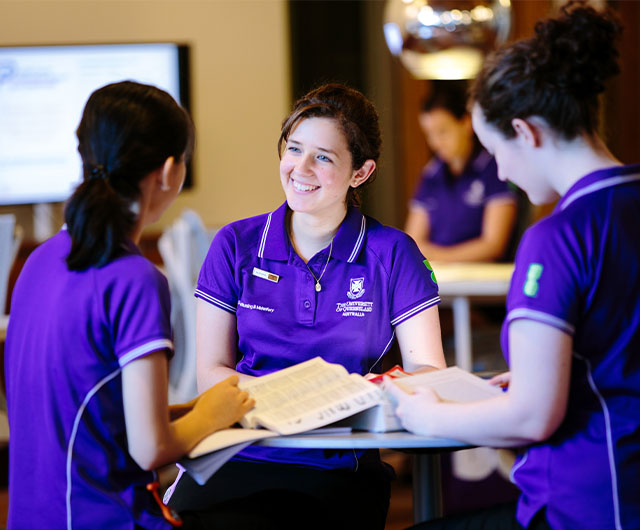 UQ’s Centre for the Business and Economics of Health (CBEH) supervises Higher Degree Research students in multiple disciplines, including economics, business, pharmacy, public health and more. Our students are characterised by their commitment to finding new ways to think about improving health care systems – through advances in methods, policies, models of care, workforce design, and financing, among others.
CBEH provides students with development opportunities through Research Assistant roles on a variety of projects.
Collaborate with UQ’s leading academics and researchers on a selected project and gain hands-on experience in research-related activities. This program offers you the chance to extend and apply your discipline-specific knowledge while building valuable research skills and professional capabilities.
Read more about the Summer/Winter research programs and how to apply
Summer and Winter research projects
Summer 2027 research projects
The program runs for six weeks, from 11 February to 19 February 2027.
Applications open September and close at end of October - date TBC. To be considered, you must submit your application through the online portal before the closing date.
For details on eligibility and how to apply, visit UQ Research Experiences.
Available Projects
Cost effectiveness of early access to public dental care in improving oral health outcomes of Queensland Childre
Hours of engagement & delivery mode: Engagement hours will range from 20 to 36 hours per week, with an expected average of around 30 hours per week. The program will be delivered through a hybrid arrangement, allowing for both on-site and remote participation.
Project Description: Queensland children are eligible to receive public dental care when they are at the age of the 4 to Year 10. The younger children 2–4 year olds are eligible only if they qualify for the Commonwealth Child Dental Benefits Schedule. The current recommendation is that the children should visit their dentist when they have their first baby tooth (6 months to 1 year). Since the eligibility criteria is set for over 4 years of age, most children ended up in the dentist when they have severe toothache or infection. Missing an opportunity for early identification and early intervention creates costly dental problems among Queensland children. Therefore, the proposed study will assess the cost effectiveness of improving the access to dental care among children in terms of incorporating the 0-3 age group eligibility to receive public dental care compared to the standard of care (access from 4 years of age).
The student will complete a quick literature search to identify similar health economic studies and model structures that can be used in the proposed study. Also, student will complete the initial data tables and actively look for possible data sources to populate the model, under the guidance of the primary supervisor.
Expected learning outcomes and deliverables: By the end of the project, student will be able to complete the identifying similar health economic models and data sources to populate the model.
Suitable for: Students with health, economics or business background will be a good fit for the study. Students with systematic literature search will be preferred. No prior knowledge of health economic modelling is required.
Primary Supervisor: Dr Ruvini Hettiarachchi
Further information: Interested applicants can contact Dr Ruvini Hettiarachchi (r.hettiarachchi@uq.edu.au) for further information.
Understanding the Theranostic Radiopharmaceutical Landscape in Australia
Hours of engagement & delivery mode: Engagement hours will range around 35 hours per week. The program will be delivered through a hybrid arrangement, allowing for both on-site and remote participation.
Project Description: Radiopharmaceuticals are emerging as next generation medical technologies for addressing complex health challenges, and their manufacture offers significant economic benefit to Australia. An important aspect to facilitate translation and improve patient access to new radiopharmaceuticals is to get those products listed on Medicare and/or the Pharmaceutical Benefits Scheme (PBS). The overall aim of this project is to apply translational health economic principles to improve patient access to value-based radiopharmaceuticals. This research project involves conducting a Delphi Panel to evaluate the current access of the theranostic radiopharmaceuticals in Australia for the adult cancer population.
Expected learning outcomes and deliverables: The scholar will gain practical experience in conducting literature reviews, undertaking statistical analyses, and developing critical-thinking and problem-solving skills by addressing real-world research questions. The project may also provide opportunities to contribute to research publications and present findings at a research conference upon completion of the project.
Suitable for: This project welcomes applications from Bachelor’s / Master's level students with backgrounds in statistics, biostatistics, health economics, health service and policy, pharmacy or other related backgrounds
Primary Supervisor: Dr Yufan Wang
Further information: Interested applicants can contact Dr Yufan Wang (yufan.wang@uq.edu.au) for further information.
Economics and Vascular Access: Using big data to answer local questions.
Hours of engagement & delivery mode: Engagement hours will range from 20 to 36 hours per week, with an expected average of around 24 hours per week. The program will be delivered through a hybrid arrangement, allowing for both on-site and remote participation.
Project Description: Drawing on existing clinical research datasets and healthcare resource-use information, this project will explore how patients move through different vascular access pathways, including successful insertions, device complications, replacement procedures, and escalation to alternative vascular access devices when required. The project will also contribute to understanding the economic consequences of these different care pathways and how evidence can be used to inform healthcare decision-making.
Students will gain practical experience in health services research and health economics within a real-world healthcare context. They will develop skills in data management, literature searching, critical appraisal, quantitative analysis, interpretation of research findings, and scientific communication. Participants will be introduced to concepts used in economic evaluation, including healthcare costs, resource utilisation, patient outcomes, and decision-making in healthcare systems. Through engagement with researchers from clinical and economic backgrounds, students will gain insight into how evidence informs healthcare policy, practice, and quality improvement initiatives. The project will also strengthen transferable skills including problem-solving, teamwork, project planning, presentation, and academic writing, providing a strong foundation for honours/postgraduate study.
Expected learning outcomes and deliverables: By the end of the project, students will have contributed to a broader program of research examining patient outcomes, healthcare resource use, and the economic implications of vascular access care. Expected outputs may include evidence summaries, descriptive analyses, data visualisations, research reports, or contributions to conference abstracts and manuscript preparation. Findings generated through the project will support ongoing efforts to understand the value and impact of different approaches to vascular access management and may help inform future research, quality improvement initiatives, and healthcare decision-making.
Suitable for: This project is well suited to students with interests in health economics, health services research, and biostatistics. Prior experience in research or statistical analysis is highly desirable. We are seeking students who are curious, motivated, detail-oriented, and willing to engage with complex healthcare questions. Students considering an honours program, postgraduate coursework, higher degree research, or careers involving health policy, clinical research, or healthcare management are particularly encouraged to apply.
Primary Supervisor: Prof Joshua Byrnes
Further information: Interested applicants can contact Prof Joshua Byrnes (j.byrnes@uq.edu.au) for further information.
Economic Evaluations of Early Diagnostic Approaches for Dementia and Mild Cognitive Impairment: A Scoping Review
Hours of engagement & delivery mode: Engagement hours will range from 20 to 36 hours per week, with an expected average of around 30 hours per week. The program will be delivered through a hybrid arrangement, allowing for both on-site and remote participation.
Project Description: Dementia and cognitive impairment are critical issues in aging populations and have a great impact on healthcare resource utilization. The impact could be greater and more detrimental not only for people with dementia but also for their carers if those cognitive impairments are undiagnosed or diagnosed at a later stage. Thus, many public health and research programs tend to focus more on awareness and early detection of cognitive impairments. At the same time, economic evaluations of these new programs have expanded rapidly in recent years. In this project, we will perform a scoping review of the existing economic evaluation literature on early diagnostic approaches for dementia and cognitive impairment. The aim of this project is to map the economic evaluation and costing literature on early diagnostic approaches for major types of dementia and cognitive impairment across etiological subtypes.
This project offers students the opportunity to develop a range of research skills that are highly transferable across academic and applied settings. First, they will gain hands-on understanding of the full process of conducting a scoping review, including an orientation to how the systematic search was designed and executed. Second, they will build competence in screening, selection, and evidence synthesis, which are among the most essential skills in research. Third, they will develop practical experience using reference management software (e.g., EndNote) and specialised tools for scoping and systematic reviews (e.g., Covidence). Finally, students will gain valuable exposure to the approaches and methods of economic evaluation in health economics, an increasingly important field within applied economics and health policy.
Expected learning outcomes and deliverables: This project offers students the opportunity to develop a range of research skills that are highly transferable across academic and applied settings. First, they will gain hands-on understanding of the full process of conducting a scoping review, including an orientation to how the systematic search was designed and executed. Second, they will build competence in screening, selection, and evidence synthesis, which are among the most essential skills in research. Third, they will develop practical experience using reference management software (e.g., EndNote) and specialised tools for scoping and systematic reviews (e.g., Covidence). Finally, students will gain valuable exposure to the approaches and methods of economic evaluation in health economics, an increasingly important field within applied economics and health policy.
Suitable for: This project is best suited to postgraduate students in economics, particularly those with an interest in health economics, applied research, or evidence synthesis. Some prior exposure to literature reviews, reference management, or economic evaluation methods would be an advantage, though it is not essential, as full guidance will be provided throughout the project. Above all, we are looking for students who are flexible, reflective, and genuinely enthusiastic about learning new ideas, tools, and research approaches.
Primary Supervisor: Dr Sabrina Lenzen
Further information: Interested applicants can contact Dr Sabrina Lenzen (s.lenzen@uq.edu.au) for further information.
UQ provides access to world-class facilities and reputation, as well as development support for students.
CBEH researchers work across multidisciplinary projects and provide primary and associate supervision opportunities for master's and PhD student projects, meaning our students may be enrolled through the UQ school that is best aligned to their research focus.
Visit the Study at UQ website for full details of enrolment and opportunities available - information is available on postgraduate coursework and higher degree by research admissions.
There are a number of scholarships available to postgraduate and HDR students that can assist you while completing studies with the Centre for the Business and Economics of Health.
As eligibility can be dependent on the school your program is associated with, students are encouraged to check which are available and to note the relevant eligibility requirements, closing dates and contact details.